Read the Manifesto
Written by Barabeke. Intellectual and spiritual challenges welcome. All is up for debate and subject to modification — except the 13 sacred axioms.
How the 13 axioms translate into a culture that addresses the problems of today and the challenges the future holds.
Written by Barabeke. Intellectual and spiritual challenges welcome. All is up for debate and subject to modification — except the 13 sacred axioms.
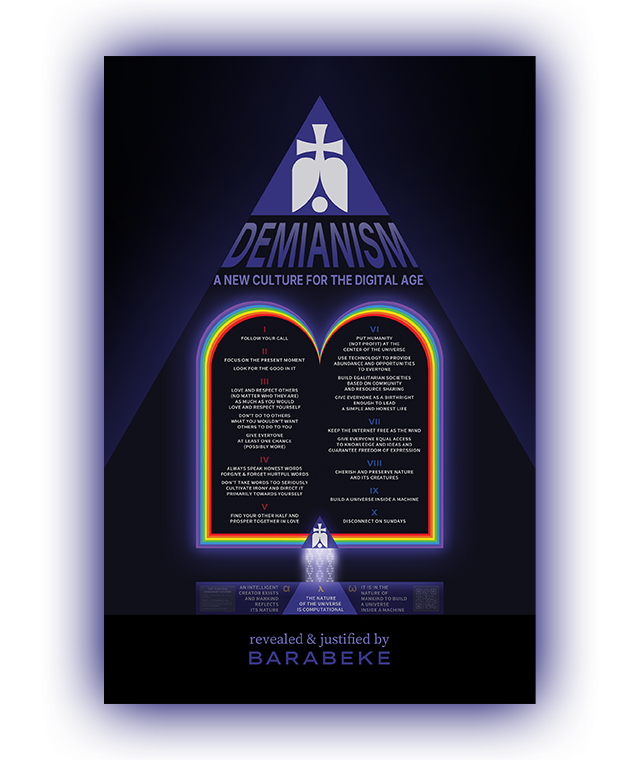
In the Book of Demianism you’ll find Barabeke’s commentary on each axiom, the story behind Demianism, and bold ideas for the future inspired by the 13 axioms.
Demianism was born in a context of profound cultural war. I could have created it as early as 2015, but I saw neither the necessity nor the urgency then. It was the decadence of the times — and the absence of any light of hope on the horizon — that drove me to bring Demianism to you.
More than a cultural war, what we are living through is a spiritual war. Demianism, unlike other far more established spiritual traditions that seem to have forgotten their own doctrines, knows how to distinguish good from evil. It is not afraid to call evil by its name, and opposes it with resolve.
Examples of evil that may sound familiar to you:
In other times, any of these diabolical acts would have been considered enough to justify lynching, being thrown from a cliff, or being hanged from the nearest tree. Our ancestors were rougher than we are, but at bottom we are still the same sapiens. I believe the anger of the people is mounting, and that we are headed toward times of great conflict and violence.
The Demianist is called to resist oppressors and never to bow their head to them. The Demianist is also called not to use violence, except in legitimate self-defense.
The Demianist is called to always be honest, to use harsh words when necessary, but to direct their indignation and anger at the sin rather than the sinner — at lobbies and organized groups rather than individuals, at the powerful rather than the weak. We do not go after individuals with hatred and cruelty. We abide by the standards of the free world, which are reflected in our ethics, and we use the weapon of irony to shatter the illusions of propaganda and exorcize evil.
Demianists cannot knowingly affirm lies and, when wrong about something, are called to correct themselves, and where appropriate, to apologize. This honesty of ours, which has a sacred foundation, will pay off in the long run: it will earn us people’s trust.
In the event of a totalitarian regime, we will continue to practice our values and uphold our standards. The more truth is distorted or inverted, the more loudly we will proclaim it. Whatever persecutions we suffer, we will endure them with our heads held high. The early Christians conquered the mighty Roman Empire by behaving this way — through public witness, refusal to recant under persecution, moral example, and community solidarity.
Doesn't sound very inviting, isn't it? I am afraid there no is other solution that is as graceful and merciful. You can hide or embrace the madness of the times for quiet living. But the consequences of this absolute moral decadence will ultimately hit you and your descendants hard. Those who care about humanity have a duty to resist. I am offering a bold but peaceful and dignified way to do it.
Barabeke

